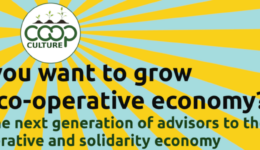
Are you an advisor to co-ops or community businesses with no, or limited, experience of finance? Book now to join Co-op Culture for a must attend workshop on the 17th January
The workshop will cover Basic Accounting Concepts and Terms and Jargon Busting, including:
An introduction to finance and accounting terms
The five different types of account
Methods of keeping financial records
The three key financial reports, and how to extract information from them
It will also link to videos for follow-up learning on:
Cash Flow Statements
Accounting for Grants
Accounting for VAT
Difference between Mark Up and Margin
Gross Profit Margin
Break Even Point
Margin of Safety and Sales Growth
The different importance of Turnover and Margin for High Volume Low Margin and Low Volume High Margin businesses.
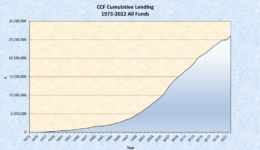
We’ve totted it all up and are delighted to announce that in 2022, we lent over £1 million, to co-operatives and community-owned businesses building the Britain WE want to see.
To everyone who was part of our 2022 we thank you and we can’t want to celebrate our 50th birthday with you this year!
We are going to be 50 in 2023 – if you’ve been part of our story so far, will you join us?
Where does the time go? One minute you’re a new social finance provider, lending to co-ops among the wholefood stores, in your 1970s flares, and the next it’s 2022, everyone’s talking about platform co-ops and you’re staring a 50th birthday in the face!
We’re planning to mark the big 50 in 2023 with a year of celebrations and we’d love you to be part of them. We want to look back over the work we’ve done – the co-ops and businesses we’ve worked with – the teams we have worked alongside – the supporters we have had – and celebrate what we built, together.
Have you been part of our story? Were you part of a co-op or organisation we lent to? A partner in a project? Are you or have you been a member or shareholder? Perhaps you are an ex Trustee or colleague?
Whatever your connection if you’ve stories or photos or memories to share we would truly love to hear from you – please, do get in touch!
Take a look at this great, inspiring, short video from our borrower Organised Kaos!
Organised Kaos began as a youth outreach project in 2007, and has now grown into an innovative and award-winning social business based in Gwaun Cae Gurwen, in the heart of South West Wales.
Organised KAOS is a contemporary Welsh Circus Company transforming lives and creating opportunities. Embedded in their communities, they Keep Adolescents Off the Streets and develop pathways for local Welsh talent, through outreach, regular classes, events and festivals.
We’ve been proud to support Organised Kaos since 2015 and have seen the results of their incredible work – the make a real difference to the people they work with and they put on an *amazing* show!
Organised Kaos are available to perform at events worldwide, including for you! Book them for your staff parties, corporate launches, open days, celebrations and events and get a guaranteed social return on your investment.
Leaseholders of Glenkerry House have secured funds for a series of works required to maintain iconic ‘brutalist’ building in East London.
A Grade II listed building, Glenkerry House situated in Poplar within the London Borough of Tower Hamlets was designed by celebrated modernist architect Ernő Goldfinger (the inspiration for the name of a villain in Ian Fleming’s James Bond books) with the purpose of providing access to co-operative housing schemes to communities in the Greater London area. Completed in 1977, Glenkerry House was established as a Community Leasehold Housing Co-operative by the Greater London Secondary Housing Association and by 1980 was handed over to an elected Management Committee of residents.
Glenkerry House – designed by modernist architect Ernő Goldfinger
Fast forward to 2022 and residents, alongside Lamberts Chartered Surveyors, have outlined a series of property improvements based on an assessment of the communal maintenance needs of the building. Works, consisting of the external redecoration of the thirteen-storey block, together with sundry repairs to timber, concrete, and subsidiary roofs, commenced in July 2022 following delays to the plans due to pandemic restrictions.
Obtaining loans from Co-operative & Community Finance and Co-op Loan Fund (managed by CCF) to contribute to the financing of the property improvements has meant payment to contractors can be secured.
Membership of Glenkerry Co-operative Housing Association is automatically given to property leaseholders with an understanding and commitment to co-operative values and ownership being part of the application criteria.
In a joint statement Matt Beannie, Secretary and Kieran Crilly, Treasurer of Glenkerry Co-operative Housing Association said: “The value of these loans to the Association has been the commencement of much needed and welcomed improvements to our home, that ensures the continued sustainability of our unique housing model, and the revitalisation of an iconic piece of Brutalist architecture.”
Kevin Lloyd-Evans, Lending and Relationship Manager at Co-operative & Community Finance said: “We are delighted to be able to support Glenkerry Housing Co-operative. Housing Co-operatives offer an excellent opportunity to meet the affordable housing need in the UK. However, the sector is massively under resourced. Helping Co-operatives prove the model works is vitality important. London’s lack of affordable housing is well known. Our finance amount tends to be small however catalytic in nature.”
Find out more about Glenkerry Co-operative Housing Association by visiting their website.
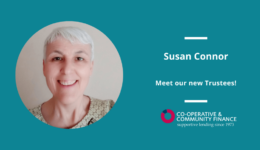
Meet our new Trustees! We are profiling three brilliant new Trustees, elected to our Board at our June AGM.
Here we talk to Susan Connor, a Funding Manager in The National Lottery Community Fund, about her experience of working in social finance, and why she chose to join us.
‘My work now is within the social investment team though I’ve been with the Fund for 16 years, and in that time, I’ve worked on a few different programs. Within my current role, I’ve worked in areas including social impact bonds, infrastructure programmes and for the last six or seven years, I’ve been managing the Growth Fund – a blended finance programme. So my experience of social finance here has been varied.
I’m really interested in the way we at the Fund, and the sector more broadly, provides support for VCSEs. When research showed there was a need for smaller loan deals for social enterprises, we worked to develop The Growth Fund and it’s run in partnership with Big Society Capital, and delivered by Access The Foundation for Social Investment. Essentially, it was designed to provide the finance that charities and social enterprises need for growth or for diversifying their business models. By blending loans (from BSC) and grants, (from the Fund) in the form of small, flexible, unsecured loans it became more accessible for organisations that might not have considered social investment before…. So the Growth Fund makes up to £150k available; it’s a really different scale to what’s been on offer before.
Social finance is so important, in that it can provide an opportunity for organisations to take back a lot of control as to how they use money. Grant money comes with restrictions, and it is often project based. Social finance gives that little bit more freedom for an organisation to diversify their income and try out something in a slightly different way than they may have thought of before. Because of that it’s really exciting – an organisation which has a fantastic idea can jump on it straight away.
I’ve seen some fantastic projects develop. One organisation I remember was looking at erecting a straw bale building. As we chatted, I realised they didn’t have a sense of how much money they were making – they didn’t recognise that the money they were bringing in from providing school services was income. It was great to work with them, to draw out their ideas a little more so that they could see this could be used to grow. And another project, early on – it was coffee shop training ex offenders to be baristas. They were looking for a really low amount of money, under £10k, as social investment. It was such a tiny amount, and they wouldn’t have got it anywhere else.
The Growth Fund is coming to an end in its current form and the learning from it is already being implemented by others in the sector, to develop new funds and products, I’m looking forward to seeing what comes next, and how my experience can play into my new part in CCF.
Locals look to improve the wellbeing and social glue of the community through the purchasing of their village pub with help from Co-operative & Community Finance’s ‘More Than a Pub’ finance package.
The Prince of Wales pub has served its community for hundreds of years dating back as far as the 17th century.
Located in hamlet of Newtown in St Martin within the Lizard Peninsula of South West Cornwall, The Prince of Wales pub has served its community for hundreds of years dating back as far as the 17th century as the village’s only pub. After closure during the pandemic in 2020, locals have come together to organise the purchase of the pub developing a business that is community driven and provides customers with greater opportunities for connection.
A survey was conducted by residents towards the end of 2020 and following a swell of support from the village for community ownership, ‘Friends of the Newtown St Martin Pub Ltd’ was formed as a Community Benefit Society in February 2021. Along with a community share offer and help from Co-operative & Community Finance’s ‘More Than a Pub’ finance package, the society has been able to obtain the funds necessary for the freehold purchase of the pub as a community asset.
Food, live music, and a family room have been put forward by the community as important elements in the pub’s development. Regular activities such as quiz nights, Young Farmers socials and being used for the local darts team and Euchre club (which lapsed after the pub’s closure) are set to resume. The society also hopes to revive an informal ‘Trades’ evening hosted by the pub which brought together tradespeople across the area one evening a week as well as creating new clubs for gardeners, writers, a book club and cinema club. After identifying individuals in the village with significant caring responsibilities, a carer’s support club is another opportunity to use the pub to bring the community together along with potential plans for a shop within the pub to service the village.
Katie Nightingale, Chairperson of Friends of the Newtown St Martin Pub said: “Whilst this journey has been long and arduous, we simply could not have achieved what we have without the incredible support from Co-operative & Community Finance. The process can be complex at times and the expert advice provided was truly invaluable. Our community is absolutely thrilled at what we have achieved and the re-opening of the pub will make a huge difference to our villages and surrounding areas.”
The Prince of Wales pub, Newtown-in-St-Martin
The loan finance from Co-operative and Community Finance is the very last loan from the original ‘More Than a Pub’ programme, a loan product created specifically to support Community Pubs, alongside a grant from the Plunkett Foundation funded by a Power to Change and the Ministry of Housing, Communities and Local Government (MHCLG). Co-operative and Community Finance were also able to provide extra finance from their ‘More than a Pub’ legacy fund and the pub group were successful in receiving a grant from the Community Ownership Fund. Tim Coomer, Business Development Manager Co-operative & Community Finance said: “This Pub group have been on quite a journey, and we are ecstatic that their hard work, perseverance, and determination has paid off in the end. The Prince of Wales is in a pretty pub in a beautiful part of the country, but this belies some of the real issues faced in rural Cornwall, where isolation, low wages, second home ownership and high costs of living can make it a challenging place to live for many. The Prince of Wales is a pub at the heart of its community and long may it be a success.”
The legacy ‘More Than a Pub Fund’ provides loan finance of between £75,000 to £150,000 available to Community Owned Pubs at a discounted rate of interest for members of the Plunkett Foundation, length of term ranges from five to twenty years. We can also help support groups access grant funding to help get them develop their business plans and pay for surveys, etc… through the Reach Fund. Please contact Co-operative & Community Finance for the full terms and conditions, and to discuss how your Community Owned Pub venture can be supported.
You can find out more about Friends of Newtown St Martin Pub by visiting their website.
Meet our new Trustees! We are profiling three brilliant new Trustees, elected to our Board at our June AGM.
Here we talk to Owen Dowsett, a Senior Consultant at the British Council, about his experience of working in the field of social finance, and why he chose to join us.
My current job is based around the Investment Climate Reform Facility. This supports organisations in African, Caribbean and Pacific countries to create better conditions for businesses to thrive and for women’s economic empowerment and inclusion, which in turn boosts economic growth and sustainable development at large. For the first two years of my role at the British Council I was part of the global social enterprise programme. This took an ecosystem approach, not supporting social enterprises or entrepreneurs directly, but informing policy and education and finance systems to build the conditions for social enterprises to thrive.
My previous job was within the Equality Impact Investing Project and that was all about trying to bridge the gap between the equality sector and social investment in the UK, looking at how social investors could better promote equality using a number of different strategies. These strategies often involve looking at the diversity of people invested in, and their teams, or how their work promotes equality. CCF and its target borrowers offer another aspect which I’m interested in which goes beyond the who and what described above and looks at how borrowers are organised, ie, democratically, often with flat structures – this is where at least some of the equality impact lies.
I’ve seen time and again that there is an interest on both sides – there is a keenness to invest and a demand for the investment. I think it’s really important to be clear that while there is a need for capital for income for all sorts of organisations, social investment isn’t suited to every organisation. There was historically a risk that this was being positioned as a direction for everyone which could have justified the reduction in grants etc – we have to remember that there are and always will be projects that can’t work with repayable finance. But for those that suit it, there are lots of things that can be done to turn what they do into something that pays back. That can happen through all kinds of models – for example, services could be chargeable at different rates in different sectors to subside the work with key beneficiaries. The main thing is that investors and investees need to be willing to express needs and concerns, and ask questions, especially when things are unknown. And both need to hear those of the other party.
The opportunity with CCF felt really attractive to me. As a lot of my work at the British Council is and has been international, I’ve missed having a focus in the UK. And I live in Bristol, where CCF is headquartered, so that’s even more local to me! I am very keen to learn about cooperatives – even though they are such a globally accepted model, I’ve not really engaged with them before. I’m really looking forward to learning more about the cooperative sector – how it works, what coops feel like and look like on the ground, and meeting the people within them.’
We’re pleased to be working with Owen – welcome to the team! Meet the rest ofour Trustees here
Meet our new Trustees! We are profiling three brilliant new Trustees, elected to our Board at our June AGM.
Here we talk to Maggie Rodriguez-Piza, Chief Executive, Funding London, about her experience and interest in social finance, and why she chose to join us.
‘My experience of social finance started when I came toFunding London over 10 years ago. As an investor, our mission is to support the economic development strategy for London through our fund – we bridge the funding gap for SMEs in London and enable real opportunities for sustainable growth. From time to time, that’s seen us lending to social enterprises and more recently, specifically targeting under represented groups, for example women and minoritised groups.
The support we have provided to social enterprises has really helped us learn, and we have seen first hand what an impact it can have in tackling issues that are very local to a community. We’ve supported lending from buying buildings and creating community centres, to supporting groups working do things that are good for the environment, to other end of spectrum, we have supported organisations that are very passionate about children and young people – and particularly children and young people in marginalised and deprived communities – and the issues they face. The challenge is always around how to amplify that impact. How can we best support organisations doing really great things, that need finance over time to expand their impact?
Social finance has huge benefits. One of my favourite examples of this isChange Please. When we supported them they were very small, they had just one coffee cart in Canary Wharf. They were doing amazing work taking homeless people who wanted to get into the workforce. Working with Change Please gave them skills and supported them to change other important things – for example, they might have gained a fixed address, a bank account. But scaling was difficult. As there was only one coffee cart, there was a limit to the number of clients they could support at any one time. Social finance enabled them to buy a second cart and double their impact. They now have a roastery and actual cafes in London and Manchester. They were very smart by starting in Canary Wharf and are a really great example of how social finance can unlock a huge amount of value.
Social impact in this country is becoming more and more front of mind for even mainstream organisations. Ten years ago, it wasn’t even on the table for Venture Capitalists, whereas today it’s a growing trend. The managers of those funds have to reflect the priorities of those that invest into the funds. More and more, impact and social good are becoming ingrained in what investors are looking for, so as a result, social finance in general will become more important as we look for ways to recover from the pandemic and the economic turmoil we’re experiencing in this country. I see that as a really great future and I’m looking forward to being part of it.
Our friends at Plunkett Foundation are running what will be an incredibly useful webinar on the 20th October
Hosted by Plunkett, the webinar will include input from energy saving solutions company Gaeltel, who have worked with Plunkett to do detailed energy surveys of two community businesses.
The session will share their findings and recommendations for minimising energy consumption and making cost savings. It will explore:
· What temperature should your heating/aircon be set to for optimum use?
· Do your chillers/freezers generate enough sales to keep them running?
· Could solar/wind power/heat pumps be of use to make your business more energy self-sufficient?
This kind of proactive short and long term planning will prove essential with the onset of winter and the unknown levels of price increase to come.